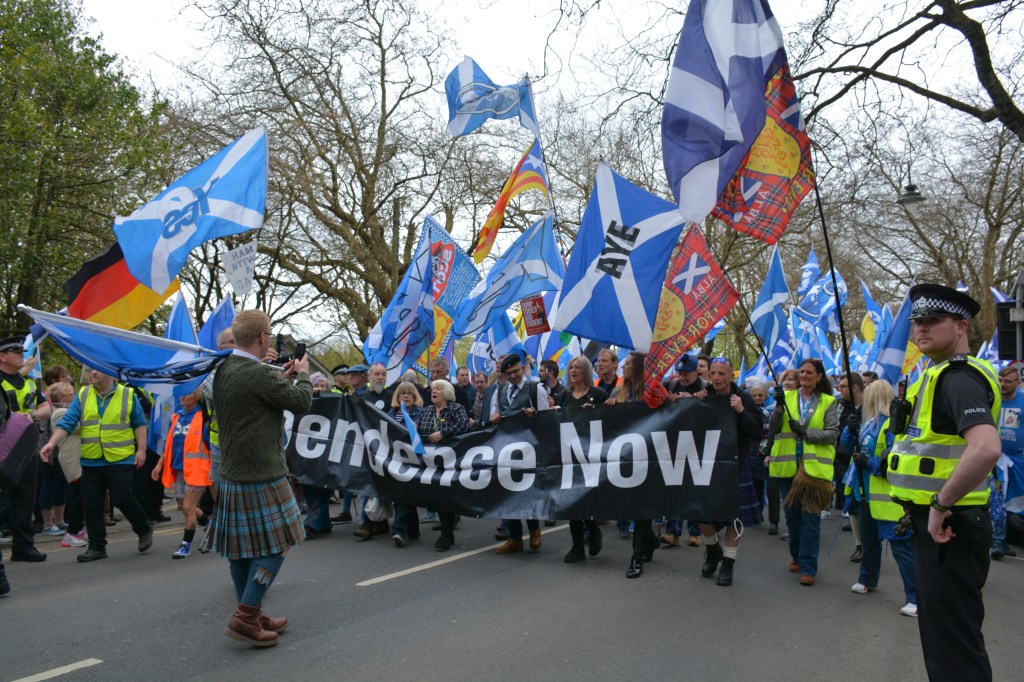
Scotland is once again trying to separate itself from England and the rest of the United Kingdom. However, a recent decision in the U.K.’s Supreme Court has shot down hopes for another referendum. Seeing as Scotland, England, Wales, and Northern Ireland have been bound as one kingdom for so long, a Scottish secession would have major geopolitical and economic consequences.
On November 23, the U.K. Supreme Court ruled that Scotland cannot hold a new referendum on their independence without the explicit consent of Britain. The decision represents the view of the U.K. government, who have long stated they will not approve a second referendum, citing the result of the 2014 vote as set in stone.
Nicola Sturgeon, the Scottish First Minister, explained that she respects the ruling but wants to continue fighting for Scotland’s independence, saying Scotland’s “democratic right to choose our own future” was at stake. She also notes that a new vote to secede is especially necessary, as the majority of the Scottish Parliament supports independence. The Scottish government wants to make sure that the decision is revisited as many politicians campaigned on a promise of a new referendum. The recent exit of Britain from the European Union was both polarizing and unpopular, especially in Scotland, something many politicians in Scotland argue has changed the view of its population on the issue of independence.
On the other hand, the central U.K. government in London argues that a Scottish secession would constitute a monumental change for the entire country, and thus can only be decided by the central government. The court agreed, saying “a Bill which makes provision for a referendum on independence – on ending the sovereignty of the Parliament of the United Kingdom over Scotland — has more than a loose or consequential connection with the sovereignty of that Parliament.” The verdict was unanimous amongst the five justices. The U.K Prime Minister, Rishi Sunak, also weighed in and urged politicians to focus on more pressing issues, such as the rising cost of living.
Sturgeon fired back, saying “a so-called partnership in which one partner is denied the right to choose a different future … cannot be described in any way as voluntary or even a partnership at all.” She also claimed that she won’t hold an unauthorized referendum and that if she were to, it would not be legally binding, and thus wouldn’t necessarily take Scotland out of the U.K. Sturgeon did, however, state that she would focus on secession in the next U.K. national election, but polls suggest that Scottish voters are nearly evenly split on independence.
If Scotland and England were to separate, it would have major implications for both parties. The two countries have been officially united since 1707, but a century earlier, James VI had already united England, Scotland, and Ireland for a short period of time. This unity did not last long, however, as he was unpopular and unseated during a century-long period of political unrest. In 1707, after a failed Scottish colony in Panama that left them economically weak and uncertainty in the parliament, the country worked out a deal with England that gave them a disproportionately low number of votes in the British Parliament, but access to England’s vast trade network and economy. England standardized Scottish coinage, taxes and trade, but Scotland was left with control over education, law, and religion. Over the following centuries, Scotland was largely united with Britain, but eventually questions of independence began to rise. These sentiments slowly gained traction, until eventually the Scottish Nationalist Party began to win seats in parliament. In the 1970s they held a successful independence referendum, but it was void due to low turnout. In the 1990s they tried again, this time with much higher turnout, and were able to establish a decentralized Scottish government. The SNP won a majority in 2011, which they used to hold the 2014 referendum.
Scotland’s recently renewed bid for independence, although partially stopped by the recent U.K. court ruling, is still a huge issue in the Scottish government. Throughout their long history together, Scotland and England have had periods of both tension and peace, and right now it is certainly the former.
By Max Langhorst


Leave a Reply