Isabella Park ’26
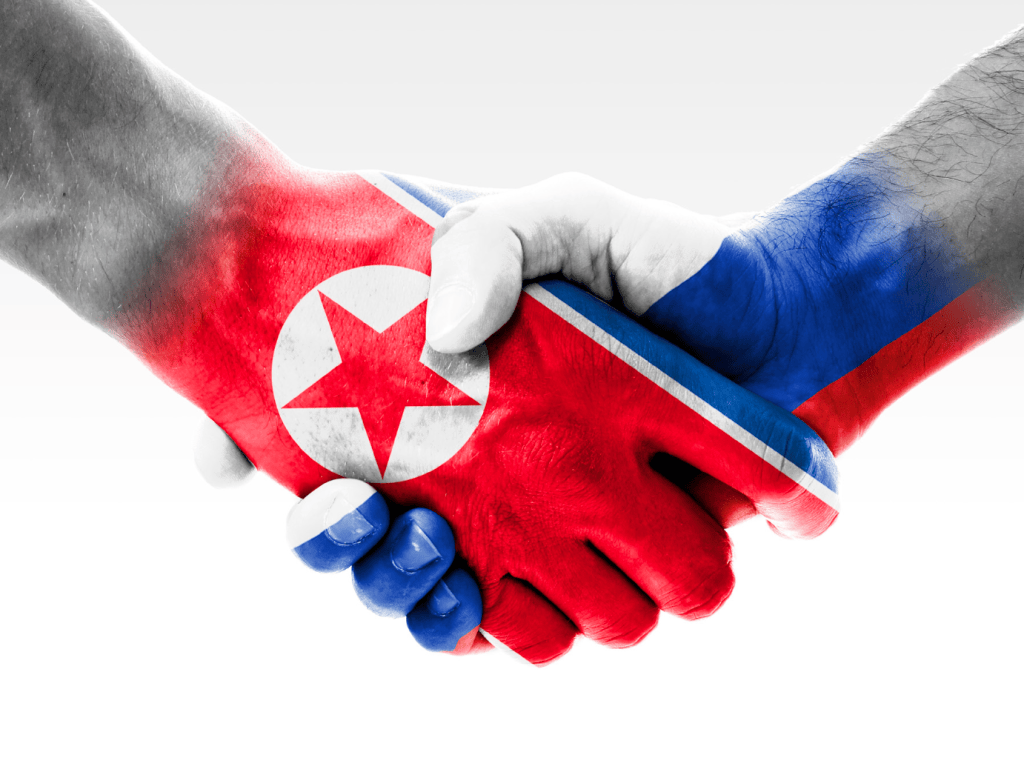
One-Line summary: The recent use of North Korean missiles in Russia could bolster the Russian military and forebode a stronger alliance between Russia and North Korea.
As the Russia-Ukraine War approaches two years, both sides seem to be reaching a stalemate as they face issues of dwindling ammunition and resources. However, Russia’s use of supplemental North Korean missiles after arms deals prompts the question of how much Western support is sufficient to bolster and continue the Ukrainian war effort. Additionally, North Korea’s official rejection of reunification with South Korea through the demolition of a symbolic monument in Pyongyang, the firing of missiles during weapons tests off the western coast, and the now renewed North Korean involvement in the illicit arms dealing market with Russia increase concerns about the autocratic country’s growing international belligerence.
In October of 2023, the White House stated that North Korea had provided the Russian military with ballistic missiles and artillery. After manufacturing military supplies in Najin on the northeastern end of North Korea, the government transported 300 containers of weapons to the Russian western border through sea and land routes. An announcement followed in January 2024 confirming Russian use of such weapons in Ukraine. The Britain-based Conflict Armament Research confirmed that Russia had fired a North Korean missile in the bombardment of Kharkiv, discovering the Korean character ‘ㅈ’ present on the missle and identifying distinct bolt patterns and jet vane actuators that suggested the missile was the new North Korean KN-23 or KN-24 model.
A revamped Russian military supply complicates the Ukrainian war plan, as Ukraine faces a lack of ammunition and military resources. Even though European nations have pledged to supply artillery shells, they have only managed to gather 300,000. Even though the vast majority of North Korean artillery is of subpar quality or obsolete, the weapons still enable the Russian military to pursue its tactic of ‘human waves’, continuously sending soldiers into combat zones without sufficient training. The additional missiles also pose a burden on Ukrainian air defense systems, since the Ukrainian military owns a limited supply of specialized interceptor missiles.
The use of North Korean missiles in Ukraine also provides the North Korean military with an opportunity to test new technology, creating international concerns about possible military advantages for North Korea in future conflicts. Given that the KN-23 and KN-24 missiles are relatively new, the North Korean military has not sufficiently tested missile efficacy against Western defense systems. The Ukrainian military has been equipped with the Patriot surface-air missile defense system. By having the KN missiles deployed by Russia in active combat situations against Ukrainian Patriot batteries, the North Korean military can simulate missile efficacy in potential future conflicts. Having access to such information may allow North Korea to optimize the missiles against the Patriot system, providing the country with a military advantage against several NATO members, US allies, who also employ the Patriot air defense system. Technological improvement of North Korean missiles would especially concern South Korea and Japan, two proximal nations that rely on the Patriot battery system.
Beyond direct North Korean aggression, North Korea’s ability to engage in illicit arms deals sheds light on the shortcomings of sanctions. After North Korea left the Nuclear Proliferation Treaty in 2003 and conducted its first nuclear bomb test in 2006, the United Nations Security Council imposed sanctions on the country through Resolution 1718. The number of sanctions against North Korea has increased with the country’s expanding nuclear arsenal. These sanctions limit the trade of various resources to North Korea and the country’s use of foreign financial institutions. Despite these restrictions, the North Korean government has smuggled oil by taking advantage of the opaque shipping industry, as revealed in a New York Times investigation in 2021. However, the long-distance shipping of military equipment carries higher chances of detection. As such, Pyongyang has decreased arms deals recently (with the exception of supplying Hamas with grenade launchers), unlike in the 1980s-1990s when North Korea supplied weapons to Iran, Libya, Zimbabwe, and Yemeni Houthi rebels. The recent smuggling of resources has mostly focused on propping up the regime and has largely excluded arms deals. However, the rise of Russia as a potentially reliable military ally demonstrates that North Korea’s ability to overcome sanctions and participate in arms deals could not only help domestic affairs but also other oppressive regimes. Due to their geographic proximity, this exchange could lead to more substantive military cooperation, such as Russia providing its MIG fighter jet technology to North Korea or conducting personnel exchanges.
Individually, North Korea poses a larger global threat due to the nation’s missile tests in Ukraine, and the country’s ability to overcome arms deal sanctions suggests both the growing power of North Korea and its effect on other autocratic nations. As of now, both the Russian and North Korean governments have strong incentives to cooperate militarily to fortify their resistance against Western allies. Although less than 50 missiles have been transported to Russia so far, the arms deals signal the beginning of a continued strategic alliance. At the same time, the unpredictability of both Putin and Kim Jong-Un makes it impossible to predict how the arms deals will affect the Russia-Ukraine war outcome and the longevity of Kim Jong-Un’s regime. Regardless of long-term outcomes, Western support for Ukraine will need to increase considerably due to Russian increases in supplies.
Sources:
https://www.cfr.org/backgrounder/north-korea-sanctions-un-nuclear-weapons
https://www.theatlantic.com/international/archive/2017/08/north-korea-cheats-sanctions/536169
https://www.washingtonpost.com/national-security/2023/10/13/north-korea-russia-weapons-ukraine
https://www.nytimes.com/2024/01/22/us/politics/russia-ukraine-north-korea.html
https://www.nytimes.com/2021/03/22/world/winson-north-korea-oil-tankers.html


Leave a Reply