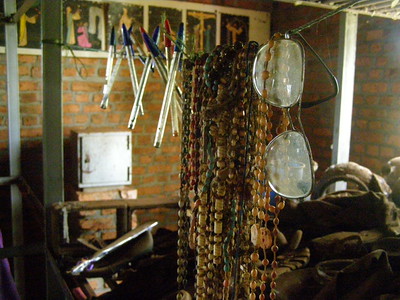
Day and night, Namisha’s residents hear bombs falling not far from their own village. Concern grows daily as villagers wonder which day will be their last. The village chief must constantly keep eyes on the fighting, utilizing the village’s high elevation as a vantage point, and closely listening to radios at all times. When fighting nears, residents of Namisha are forced to flee and take cover in the forest until the nearby bloodshed lulls. As violence spills into more areas of the eastern Democratic Republic of Congo, thousands of refugees flee to Namisha, a small village in the Fizi territory in the South Kivu province of the DRC. From Fizi alone, 300,000 people have fled the violence. The newly displaced continue to arrive, with about 2,000 refugees in Namisha. Yet they are not safe yet. Namisha is only miles away from Point Zero and Rugazi, where fighting is most intense between Rwandan-backed M23 soldiers and the Congolese army, along with local armed groups. The M23 armed group, or the March 23 Movement, an extremist Tutsi private militia, violates international law by partaking in sexual violence against women and children, abduction, killing and maiming, and forced displacement. The group primarily operates in eastern DR Congo of the Kivu regions, targeting the Hutu community. One woman named Elekena fled to Namisha from Point Zero when armed men intruded. During this hasty escape, Elekena lost 2 of her 7 children. According to the head nurse of Namisha’s health post, in January of 2026, the villagers recorded 40 deaths within the community since many could not afford or access medical care. The shortage of essential services only worsens with the arrival of the new displaced. The village rarely ever feels peace, and neither do many other areas in the eastern DRC. Conflict has been raging for thirty years now, yet few people know why. The answer stems from the Rwandan Genocide of 1994, and ultimately, European colonialism. And despite the end of the colonial era, colonial dynamics of exploiting African land and people persist through continued violence between ethnic groups.
Belgium’s colonization fueled the tension between the Hutu and Tutsi ethnic groups, resulting in the Rwandan Genocide. The Rwandan ethnic groups arose thousands of years ago: after land in modern-day Rwanda was settled by cattle farmers, individuals who owned a lot of cattle and engaged in animal husbandry were of a higher class and referred to as Tutsi, while all others, who were primarily farmers, became known as Hutus. The groups lived peacefully amongst one another, in a manner that resembled two classes in the same society. The two groups speak the same language, Kinyarwanda, practice the same religions, and live in the same regions. Prior to the abolishment of the monarchy, both Hutus and Tutsis served the same king. Additionally, before colonization, the ethnic groups were socially fluid: a Hutu could become a Tutsi, and vice versa. These components meant Rwanda’s ethnic relations differed significantly from many other ethnic entities in Africa. These pre-colonial dynamics were primarily peaceful, yet the expansion of European powers in the early modern periods would upend them entirely.
Before the late 19th century, most African territories were independent and had their own forms of government, although European imperialism still managed to fuel conflict and other forms of tension. For example, in the 15th century, Portuguese authorities provided military aid to the Kingdom of Kongo in exchange for enslaved people that the European expansion into North America demanded. In 1885 and onwards, dominating European nations placed themselves in control of ninety percent of African territories in a period of history called the Scramble for Africa. Influential leaders of prominent European nations conferenced in Berlin in order to efficiently distribute Africa’s land and resources amongst European countries, and they took charge of the lives of millions of African people, often with a disregard to their cultural norms and ethnic relations. After Germany lost its African lands following its loss in World War I, European nations placed Belgium in control of previously German territories, including Rwanda,
in 1916. Belgian authorities believed that the Tutsi ethnic group, when compared to the Hutus, possessed more “Caucasian” features, were descended from northern Africa, and were sent south to civilize the lower class. Therefore, Belgium’s government ensured that only Tutsis held power and enjoyed access to valued jobs and education in Rwanda.
To determine which individuals were Tutsi and which were Hutu, Belgian rule established ethnic identity cards in 1933 that forced Rwandans to register themselves as Hutus, Tutsis, or Twa (an ethnic hunter-gatherer community that made up 1% of the Rwandan population). As a result, Belgian rule erased the social fluidity between the groups present prior to colonization, thus pitting the groups against one another due to the unequal distribution of power. Belgians used Tutsis to manage the intense forced manual labor endured by the Hutus, causing Hutus to view Tutsis as evil oppressors, just like how they perceived the Belgian colonists. In the latter half of the 1950s, Hutu social elites who were excluded from power due to their ethnicity united to fight for a more equitable system. These activists hoped for a Rwanda in which the Hutu majority could hold power in politics and commerce, as well as pursue higher education. Their cause gained support from the Belgian colonial officers after Tutsi elites expressed their opposition to equality for Hutus. The Hutu Revolution began in 1959 and lasted until 1961, in which Belgian authorities aided Hutus in the abolishment of the Tutsi monarchy, the exile of many Tutsi elites, and the establishment of a Hutu-based government. Under the new system, Rwanda gained independence from Belgium.
The Hutu-led government, primarily holding extremist beliefs, led serious discrimination against the Tutsi minority. Under Juvénal Habyarimana, the state aimed to control the Rwandan people by creating a scapegoat for the nation’s issues: the Tutsi people. Hutu officials in Rwanda spread intense propaganda about the Tutsi population, causing many Rwandans to fear
Tutsis and therefore want to eliminate them as a preemptive attack against potential Tutsi revenge. Even as Tutsis fled into nearby nations seeking peace, tension between the two ethnic groups continued to exacerbate.
Tutsi Rwandans exiled to Uganda formed the Rwandan Alliance for National Unity in 1979, which soon became the Rwandan Patriotic Front (RPF). Its missions consisted of returning Tutsis to Rwanda and governing without ethnic tensions, yet the RPF did not always uphold these goals in practice. After extremist Tutsis under the Rwandan Patriotic Front (RPF) re-entered the nation from Uganda and presumably killed the Hutu president of Rwanda by shooting down his plane, the bloody genocide of Tutsis began, right under the noses of United Nations “peacemakers.”
The Rwandan Genocide continued for 100 days during the spring and summer months of 1994 and resulted in the slaughter of 800,000 ethnic Tutsis and moderate Hutus. The killings were carefully orchestrated by Rwandan politicians, businesspeople, and the state military. Colonel Théoneste Bagosora, as the leader of Habyarimana’s Presidential Guard, greatly aided in the creation of the Interahamwe, the paramilitary organization that was the greatest perpetrator of violence during the genocide. Bagosora trained young soldiers, encouraging them to spy on Tutsis and massacre the opposing ethnic group, and ordered weapon imports to continue the violence. Additionally, the Rwandan government utilized radios to broadcast propaganda against Tutsis and to convince ordinary civilians to partake in the massacres. A church, a building often seen as a sanctuary for the oppressed, was where the first genocidal killing took place. On April 9th, the Rwandan government abducted hundreds of Tutsis, including children, at the Gikondo Parish Church. Militiamen murdered each Tutsi in the religious building, kickstarting the genocide.
Towards the beginning of the killings, southern Rwanda remained more peaceful when compared to the state’s other regions: communities were home to both Hutus and Tutsis, where Hutus tried to protect their Tutsi friends. As violence led by the Interahamwe spread further south, the Hutus of these previously integrated communities began to slaughter their neighbors. The Rwandan Genocide strays so much from other killing events: according to The Rwandan Genocide by Zoe Lowery and Frank Spalding, never in history had so many humans been slaughtered so quickly. So many Rwandans aided in facilitating the violence: religious leaders, who brought communities together to spread anti-Tutsi hate; rich businesspeople, who donated portions of their wealth to the army; governmental leaders, who broadcast extreme propaganda; militiamen, who slaughtered hundreds each; and many more. The genocide ended after 100 days, when the Rwandan Patriotic Front, under Paul Kagame, occupied the nation’s capital, Kigali, and ousted the Hutu regime. Though short, the killing spree left around 800,000 dead, and many more traumatized and displaced. Despite the bloodbath’s end, many people were still left feeling violent and vengeful. Tension remained between the ethnic groups: many Hutus continued to harbor anger towards Tutsis due to the remaining ideas of propaganda pushed by the former Hutu government, and many Tutsis hoped for retaliation after a hateful genocide that killed many of their loved ones.
Three decades later, unresolved tensions between ethnic groups from the Rwandan Genocide continue to exacerbate strife today between government-backed groups from both DR Congo and Rwanda. Following the genocide, one million Hutus from Rwanda fled to eastern DR Congo for fear of retaliation, including many from the Interahamwe, the FLDR, and others responsible for leading the genocide. FLDR is the Democratic Forces for the Liberation of Rwanda, a Hutu armed group linked to causing and escalating the Rwandan Genocide. These extremist Hutus carried their animosity toward Tutsis over the border, fueling violence and instability between ethnic groups in the eastern DRC. Due to their immigration, the
Banyamulenge, a Tutsi group living in the eastern Democratic Republic of Congo, felt threatened. Soon after, Rwanda’s military, along with the Banyamulenge and various armed groups, attacked DR Congo’s residents with claims of targeting those responsible for the Rwandan genocide.
The Hutus’ entrance to the nation destabilized the Congolese region by increasing ethnic tensions and provoking conflict between militias, communities, and refugees. These clashes collapsed the area’s infrastructure and increased the number of refugees and Congolese locals facing hunger and disease. Over the last 30 years, Tutsi Rwanda-backed armed groups have continued to attack the Congolese people as revenge for the genocide, while the DRC-backed armed groups meant to defend Congolese people perpetuate the terror in the east of the nation through brutal killings and rapes. This complex humanitarian crisis, in addition to political corruption, instability, and unethical mining practices, has resulted in at least six million deaths over the past 30 years, making this conflict the second deadliest since World War II. In 2023, the UN’s International Organization for Migration reported 6.9 million Congolese people displaced by this humanitarian crisis.
Violence has increased since the start of 2025, when Rwandan-backed rebels overtook Goma, the most populated city in eastern DRC, and soon after, Bukavu. Despite attempts at ceasefire and peace agreements through other nations and international organizations, conflict rages on. Various armed groups and private militias fuel and perpetuate the humanitarian crisis. Upwards of 120 armed groups operate in the Congolese provinces of North and South Kivu, Ituri, and Tanganyika. For example, the FABB (Armed Forces “Biloze Bishambuke”) is one of the most powerful militias in the Fizi territory of the South Kivu province, fighting against M23 rebels. Despite the Rwandan government denying any involvement in or support for the militia, several eyewitnesses report that the group receives its supplies from the Rwandan Defense Forces (RDF). Although the national Congolese army (the FARDC, or the Armed Forces of the Democratic Republic of Congo) fights alongside the FABB, Human Rights Watch reports that this group and other Congo-backed militias commit killings, sexual violence, torture, beatings, and extortion, which is the practice of obtaining goods through coercion and threats, driven by ethnic prejudice.
Foreign intervention has so far failed to address the violence in the DRC, despite claims of peace agreements being established. For one, international organizations dominated primarily by former colonial powers have proven ineffective in fighting back against the oppression of the Congolese peoples. The International Criminal Court, or the ICC, an organization based in the Netherlands, has not indicted the Rwandan government for the human rights violations against the Congolese people despite an alarming amount of evidence from sources including the UN and Human Rights Watch. For example, the United Nations Security Council has condemned the Rwandan government for its military actions in supporting the M23’s capture of Uvira, a Congolese city on the border with Burundi, days after Rwanda agreed to peace with the DRC in Washington, D.C. In contrast, the ICC quickly condemned Putin and his administration in Russia for his war against Ukraine. If the ICC were to indict the Rwandan government and the armed militias it supports, the conflict would have a higher likelihood of coming to an end due to the ICC’s ability to prosecute those who have violated human rights. The leaders and military chiefs of armed groups such as the M23 could be arrested accordingly, aiding in preventing further conflict.
Additionally, peace agreements facilitated by the United States have repeatedly failed to produce long-lasting peace. Diplomats fail to apply “direct and consistent pressure on Rwandan and DRC leaders to stop supporting abusive armed groups,” emphasizes Tigere Chagutah, Amnesty International’s Regional Director for East and Southern Africa. In June of 2025, Rwanda and DR Congo officials met in Washington, D.C., and promised the two nations would
end all hostile acts against one another and terminate governmental support of armed groups. However, civilians in DR Congo continue to be killed and their rights violated. The Rwandan side consistently frames their military presence in the DRC as a defensive measure against the FLDR who facilitated the Rwandan Genocide. However, a Rwandan senior military advisor confessed that the FLDR poses little threat to Rwanda largely because it primarily operates in the DRC. Due to this perspective that Rwandan officials continue to push, peace is difficult to negotiate, particularly by Western nations. Patterns of exploitation from the colonial era continue to push solutions into Africa that lack nuanced thinking, therefore allowing conflicts to continue. Western governments often fail to acknowledge the negative impacts that colonialism has caused to previously colonized regions, complicating their ability to dissect post-colonial tensions necessary to speak to the root of a conflict and make peace today.
As a result of complex ethnic tensions that arose in Rwanda, Congolese people suffer even today, decades following Belgian colonization. From Rwanda, where the Hutus and Tutsis once lived in vibrant communities with social fluidity between ethnicities, animosity has spread into neighboring regions and led to the deaths of millions of people. People like the villagers of Namisha deserve to suffer no longer, and neither do any other innocent Congolese civilians. Namisha’s poor medical care and drinking water, as well as the constant danger, are not the fault of the community itself, but rather the conflict and poverty the village finds itself in.
Colonialism is ultimately the cause of the millions killed by the conflict raging today. If European nations, particularly Belgium, had not claimed control over Rwanda and the Democratic Republic of Congo, the governments of both regions would not have been destabilized and set up for political corruption and a lack of democracy, which facilitated the lack of peace. Additionally, Rwandan ethnic groups would not have been divided so distinctly in such a manner that set the stage for the Rwandan Genocide, and ultimately the bloodshed that now persists in the eastern DRC. Western nations continue to intervene either harmfully or insufficiently. Colonial forces continue exploitation today through profiting from conflict minerals extracted in mines occupied by the M23 and other militias perpetuating violence and displacement, as will be described in the next article of this series. The Rwandan Genocide’s end unfortunately never meant an end to innocent lives lost, but hope and action will propel the DRC closer to peace.


Leave a Reply